
AI Slop: Pseudo-Insights and Our Capacity for Deep Reading
Writing this piece is my attempt at a rough review and reflection on my reading habits over the past few months.
Since large language models exploded onto the scene in the second half of last year, Twitter began paying creators, and its recommendation algorithm was open-sourced — the result has been impossible to ignore: more and more articles flooding my timeline.
The topics I follow are mostly related to AI technology and its social implications. The former tends to be product announcements from tech companies; the latter, posts from authors I find credible — people whose writing lets me understand how the deepest thinkers on technology, the ones with the longest view of the future, are making sense of AI’s rapid breakthroughs.
Not long ago, finding these voices required real effort. Some were almost serendipitous discoveries. One reliable way to identify them was simple: read the words, and see through to the mind behind them.
A person with genuine depth — with an interesting soul — produces writing that moves you. Again and again you find yourself thinking, yes, exactly. Each author’s distinct voice becomes its own kind of experience, a different texture through which their insights reach you. To put it plainly: writing with a soul has flesh and blood.
That has changed dramatically. And since AI-generated writing became ubiquitous, it has only gotten worse.
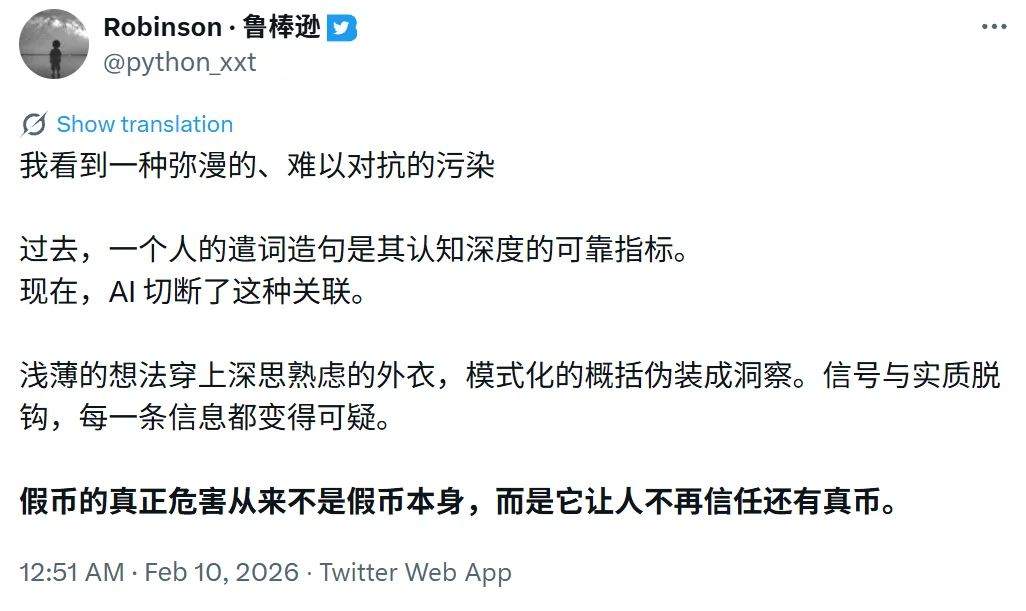
As a friend put it in the screenshot above: “Shallow thoughts dressed in the costume of careful deliberation. Formulaic generalizations masquerading as insight. Signal decoupled from substance, until every piece of information becomes suspect.”
I’ve lost count of how many articles I’ve read that follow the same template — clickbait headlines, breathless openings, endless numbered subheadings, “it’s not X… it’s Y” scattered throughout. Every time I open one of these pieces, I feel a brief, illusory pleasure. I imagine my understanding has expanded because of this article’s “insight.” I imagine I’ve unlocked some mysterious “wealthy mindset.” I imagine I’m now equipped to do something meaningful amid the sweeping tides of social change.
The reality? I’ve learned almost nothing. These AI-templated pieces — dressed up in elaborate packaging — have been fooling me with their formulaic sentences. “Shallow thoughts dressed in the costume of careful deliberation.” And I kept going back for more.
The sad truth is that this trend — or more accurately, this pollution — will only continue.
The more of this content I consumed, the more my disgust with AI Slop grew. No genuine thought, yet rushing to drape itself in the costume of “insight.” The motivations behind it are all too easy to guess, and all too disheartening.
Wasting my time is one problem. But there’s another, equally serious one: the slow erosion of my capacity for deep reading.
Pay attention to your own emotional arc while reading this kind of content. You’ll find it follows a fairly predictable cycle:
–> See the headline → curiosity / fear / shock
–> Read the opening → urgency / hunger / excitement
–> Work through lines of “it’s not X… it’s Y” → a hazy sense of understanding, a feeling of sudden clarity
–> Reach the climactic conclusion → soaring optimism, a full hit of motivational validation
Every sentence seems to be revealing the true nature of the world. Every line makes you feel like you’ve grasped the essence of change. And that final crescendo — I don’t know how many others feel what I feel: in the midst of all that excitement, actually savoring the sensation of having “won” at life.
But the articles that carry genuine insight will never leave you feeling like you’ve been injected with pure adrenaline — or at least, the gratification won’t arrive so smoothly. Real insight, almost by definition, runs against common sense. Otherwise, why call it insight at all? To lead a reader past their assumptions into new understanding requires a chain of reasoning and logic that doesn’t go down easy. More often than not, when I read something truly worth reading, I spend the first part in a state of genuine puzzlement, even disorientation — until a single pivotal sentence breaks things open, and suddenly the whole structure becomes clear. That emotional experience is something no hastily packaged AI piece can replicate.
It was precisely this realization that made me notice: after more than a month of steady AI Slop consumption, my tolerance for writing that actually demands something of me had declined. Faced with a long piece, I felt a persistent impatience — as though I were always searching, searching for that one sentence that would hand me the secret to how the world really works — while caring far less about what I actually understood afterward.
There’s something genuinely sad about writing that. The volume of AI-generated content online will only accelerate. Even if the ratio of low-quality to high-quality content stays constant, the sheer speed of AI production means that ratio plays out at an exponential scale. The true treasures in that information ocean — the pieces that age well, that reward return visits — may become harder and harder to find.
And from another angle: even if we manage to maintain some capacity for filtering, our reading ability — our capacity for deep reading — will inevitably erode. Perhaps the answer, at least for now, is to close social media and return to the classics. A temporary refuge, but maybe the only honest one we have.
Leave a comment